SharkByte Hackathon 2026: What We Saw Judging 41 Teams and 109 Hackers
Storm alerts from sensors, a scale-model building that warns when something comes loose, voice-controlled 3D printing and transfers on Solana. A tour of the projects we saw from the judges' table.
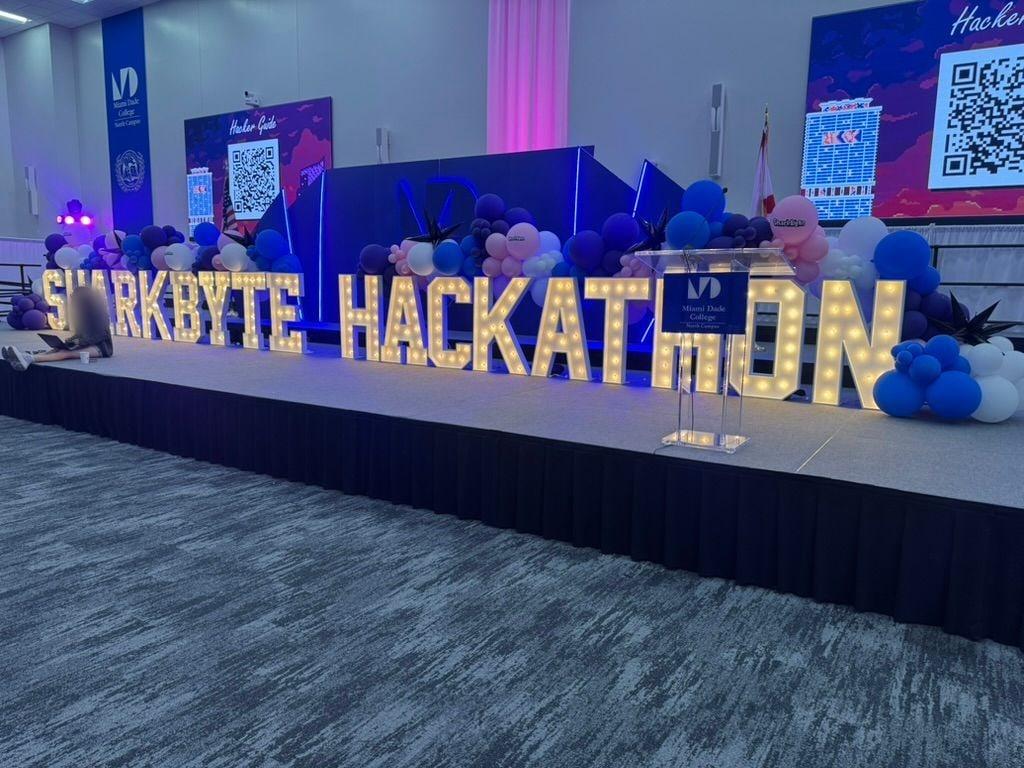
The main stage, with the SharkByte Hackathon letters lit up.
SharkByte Hackathon 2026 brought 41 teams and 109 hackers to Miami Dade College North Campus for an official Major League Hacking (MLH) event. DPCTechStudios took part as a judge: we were assigned teams 6 through 16 for overall judging. Teams also competed in categories such as the MDC Challenge, Base44 and Best Use Case for Auth0. Projects included sensors with real-time data for early storm and earthquake alerts, Morphix (voice-controlled AI 3D printing, open sourced on GitHub), Nest (cross-border transfers on the Solana network) and AI career advisors for students.
An MLH hackathon with 41 teams at Miami Dade College
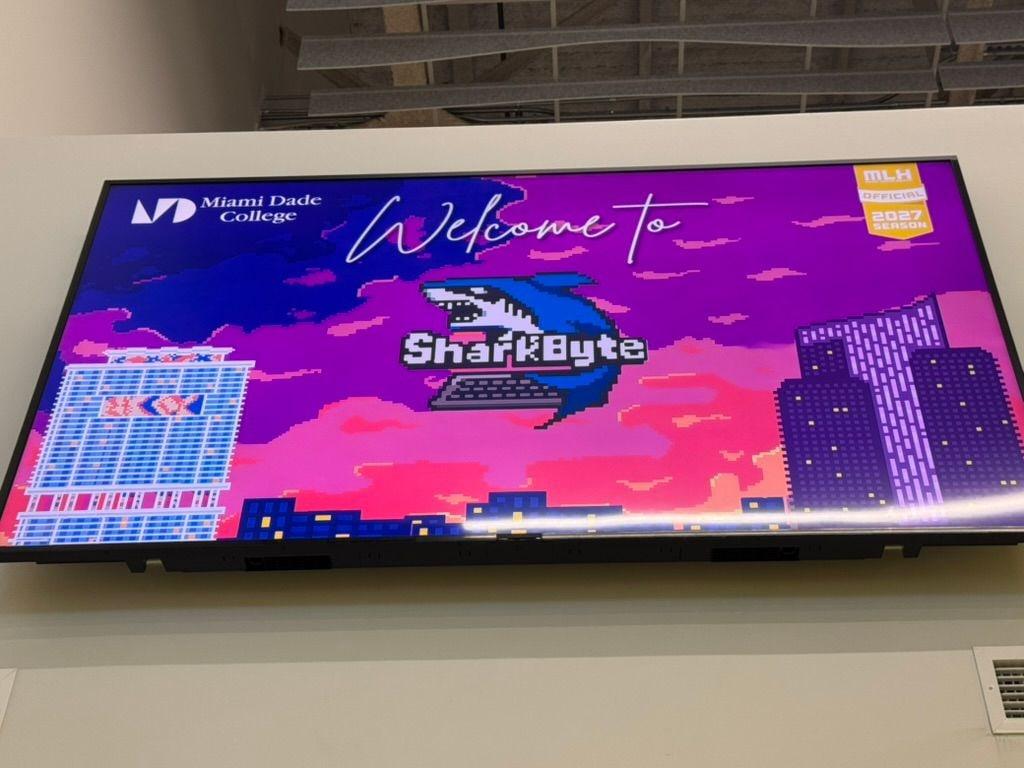
SharkByte Hackathon took place at Miami Dade College North Campus and is part of the official Major League Hacking season. 41 teams with 109 hackers in total took part. The welcome screen set the tone: pixel art of the Miami skyline, a shark in front of a keyboard and the MLH badge.
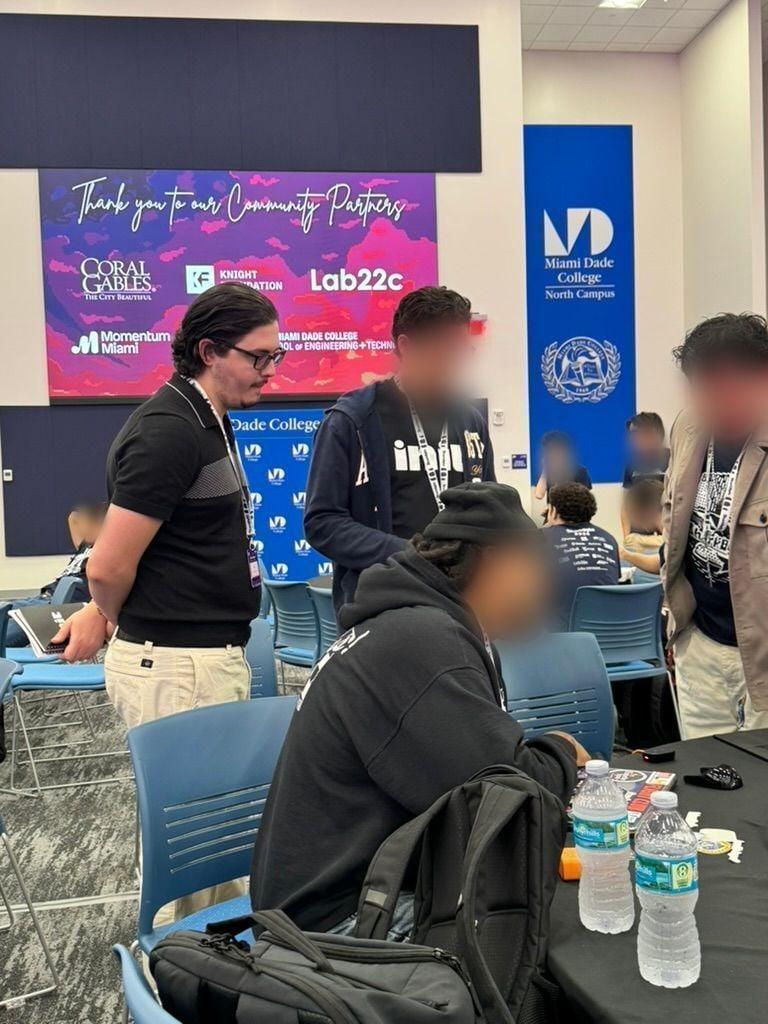
An event this size takes many hands. A screen thanked the community partners: Coral Gables, Knight Foundation, Lab22c and Momentum Miami, along with Miami Dade College's school of engineering and technology.
How we judged: teams 6 to 16, overall judging
We were assigned teams 6 through 16 for overall judging, the general evaluation of each project, which runs separately from the category prizes such as the MDC Challenge, Base44 and Best Use Case for Auth0.
Judging a hackathon project has little in common with judging a finished product. Teams took an idea to a working demo in very little time, then had to explain it to people seeing it for the first time. That last part is harder than the code.
These were the three questions that guided our judging:
- Does it solve a real problem for a real person?
- Does it actually work, or is it only slides?
- Can the team explain what they built and why, in plain words?
Talking to participants at their tables, laptops open, told us more than any presentation.
Real-time data to warn before the disaster
The trend that repeated most was real-time data. Several students built projects with sensors that analyze the weather and send early alerts for storms or earthquakes.
The one that stood out most was a scale model of a four-story building. The system detects the structure's movement. If a loose screw makes the building move more than normal, it sends an early alert so it can be repaired before an accident happens.
It is the logic behind the continuous monitoring we use with IT and security clients: catching the fault while it is still a warning. See how we monitor IT and security.
Morphix: 3D models by voice, straight to the printer
One team presented Morphix, an integration for 3D printers. You talk to an AI assistant, it generates the 3D model from the conversation and sends it straight to the printer, which prints it.
The repository shows how they built it: voice with Gemini, models generated with Meshy, a Raspberry Pi with a touchscreen connected to an Afinia printer and a system called Print Guardian that watches the print. It is a product that could be sold, and the team chose to open the code. See Morphix on GitHub.
Nest: cross-border transfers on Solana
Nest lets people make bank transfers between countries over the Solana network. Because it relies on that network, transaction fees are low.
MDC Challenge: AI career advisors
Several projects competed in the MDC Challenge. They helped students define their career goals, pick the major they wanted and get personalized help from AI advisors.
What we took away
The most interesting projects started from a concrete problem: a building coming loose, a money transfer with high fees, a student with no career direction. These students already use AI and real-time data as basic tools.
DPCTechStudios works with Miami-Dade businesses on IT, CCTV, networking, development and AI. Judging is a direct way to meet the people building technology in the same city and to give something back to the community where we operate.
Daniel Pena, founder of DPCTechStudios, is also a Miami Dade College student. Being on the other side of the table, as a judge, meant a lot.

SharkByte Hackathon 2026 FAQ
What is SharkByte Hackathon?
An official Major League Hacking hackathon held at Miami Dade College North Campus. In 2026, 41 teams and 109 hackers took part.
What did DPCTechStudios do at the event?
It took part as a judge in the overall judging of teams 6 through 16.
What criteria did the judges use?
Three questions: does the project solve a real problem for a real person, does it actually work, and can the team explain what they built and why in plain words.
What categories did the hackathon have?
Besides overall judging, there were categories such as the MDC Challenge, Base44 and Best Use Case for Auth0.
What projects did the judges see?
A scale-model building that detects movement and warns before a fault, Morphix for voice-controlled 3D printing, Nest for transfers on Solana and AI career advisors.
What comes next
We will keep publishing what we do in the community, in English and Spanish. If you are organizing an event in Miami-Dade and need judges or mentors, get in touch. Contact us.
Daniel Pena founded DPCTechStudios, a technology partner for Miami-Dade businesses: IT, CCTV, networking, development and AI under one monthly relationship. He is also a Miami Dade College student.
Organizing an event in Miami-Dade?
If you need judges, mentors or technical support for a tech event, tell us what you need.